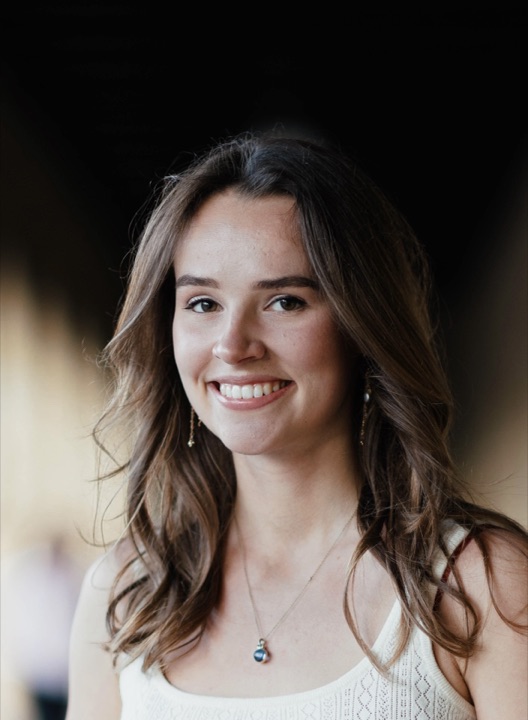
Olivia Beyer Bruvik
I'm a Ph.D. student in Aeronautics & Astronautics at the Stanford Intelligent Systems Lab, advised by Prof. Mykel Kochenderfer. I work on reliable AI for autonomous systems: knowing what learned models actually compute, and when their decisions can be trusted.
Happy to chat at oliviabb [at] stanford [dot] edu!
Education
- Stanford University - Ph.D. Student, Aeronautics & Astronautics 2026–
- Stanford University - M.S. in Computer Science (AI), with Distinction in Research 2026
- Stanford University - B.S. in Mathematics, Phi Beta Kappa 2025
Experience
- Stanford Intelligent Systems Lab - Research Assistant, Airbus and NASA projects Sep 2025–Jun 2026
- Stanford AI Lab / CyBench - Undergraduate Researcher Dec 2024–Mar 2025
- McKinsey & Company - Junior Associate Intern Summer 2024
- Google Cloud, Vertex AI - Intern Summer 2023
- Google Search, GraphMill - Intern Summer 2022
- Weill Cornell Medicine - Undergraduate Researcher 2019–2022
Research Highlights
- Aircraft landing (Airbus): derived protection levels for camera-based pose estimation that stay valid under undetected sensor faults; co-first-author paper at DASC 2026 (Best Student Paper Award, 1st place), and a second paper on interpretability of the landing model (DASC 2026, Best of Session Award). Code in RunwayLib.jl.
- Autonomous taxiing (NASA ULI): developed a Kalman-filter localization pipeline from camera segmentation, and evaluated how well its uncertainty estimates matched real error across 60 simulated trajectories; co-first-author paper at AIAA AVIATION 2026.
- AI-driven aquaculture: built a POMDP-based planning system that schedules salmon-farm treatments under noisy lice-count observations, then used importance sampling to estimate how often its decisions would violate regulatory limits; manuscript in preparation.
Selected Publications
Protection Levels for Vision-Based Pose Estimation
Beyer Bruvik, O.*, Valentin, R.*, Schlichting, M., Walker, D., Kochenderfer, M. (*equal contribution)
AIAA/IEEE Digital Avionics Systems Conference (DASC), 2026. Best Student Paper Award, 1st place.
Mechanistic Interpretability for Learning Assurance of a Vision-Based Landing System
Valentin, R., Beyer Bruvik, O., Schlichting, M., Kochenderfer, M.
AIAA/IEEE Digital Avionics Systems Conference (DASC), 2026. Best of Session Award.
Filtering Framework for Aircraft Localization During Taxiing Using Semantic Segmentation
Prince, E.*, Beyer Bruvik, O.*, Schlichting, M., Katz, S., Cahilly, C., Tzikas, A., Jamgochian, A., Moss, R., Kochenderfer, M. (*equal contribution)
AIAA AVIATION Forum, 2026.
More publications
Who Evaluates AI's Social Impacts? Mapping Coverage and Gaps in First and Third Party Evaluations
Reuel, A., et al. (incl. Beyer Bruvik, O.)
ICML, 2026.
BountyBench: Dollar Impact of AI Agent Attackers and Defenders on Real-World Cybersecurity Systems
Zhang, A., et al. (incl. Beyer Bruvik, O.)
NeurIPS, 2025 (Datasets & Benchmarks Track).
Disease correlates of rim lesions on quantitative susceptibility mapping in multiple sclerosis
Marcille, M., et al. (incl. Beyer Bruvik, O.)
Scientific Reports, 2022.
Projects
Mechanistic interpretability · Qwen2.5-14B
Can We Remove Emergent Misalignment Without Removing Capability?
CS 221M (Mechanistic Interpretability) Final Project, Spring 2026. With Nicolò Di Borgoricco.
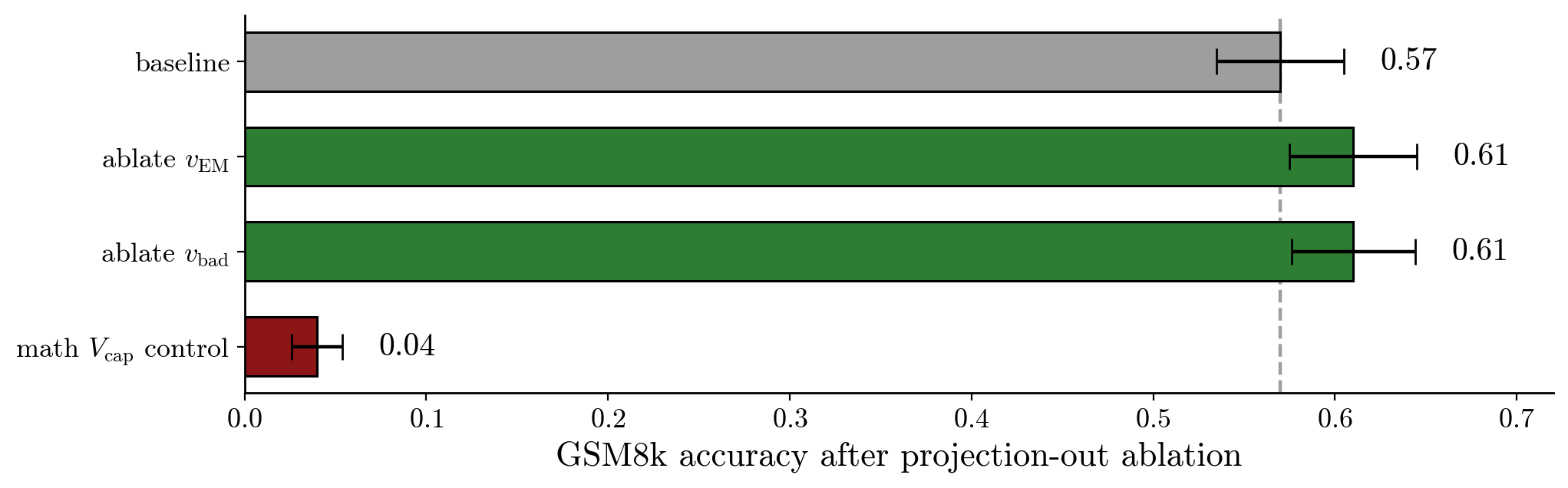
Reproduced the emergent-misalignment steering direction of Soligo et al. in Qwen2.5-14B, then tested whether ablating it costs capability: GSM8K accuracy was unchanged (0.57 → 0.61, n = 200), while ablating a capability axis built the same way dropped it to 0.04.
Poster (PDF) opens from the card · Code on GitHub
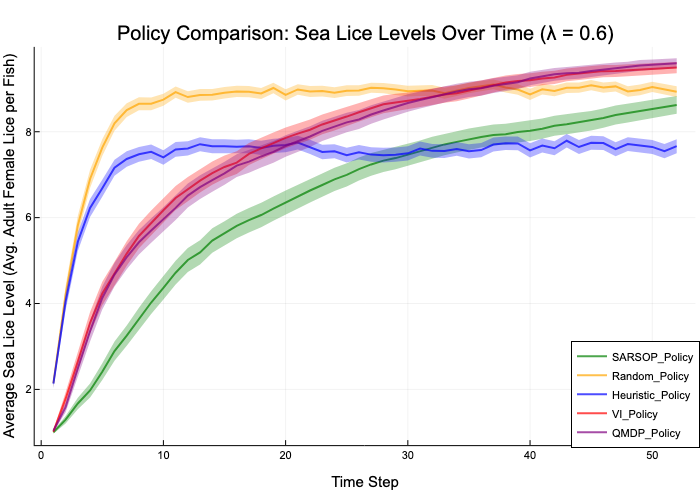
Optimizing Sea Lice Management in Norwegian Aquaculture Using POMDPs
CS 191W Senior Research Project, Spring 2025.
Developed a Julia framework using POMDPs and offline planning to simulate, optimize, and evaluate aquaculture management strategies under uncertainty. This work grew into the AquaOpt manuscript, now in preparation.
Follow-up (CS 238V, Winter 2026): validated the resulting treatment policy's failure probability against Norway's 0.5 lice-per-fish limit with Monte Carlo rollouts, importance sampling, and signal temporal logic robustness scores.
Role: Independent project under the supervision of Prof. Mykel Kochenderfer.
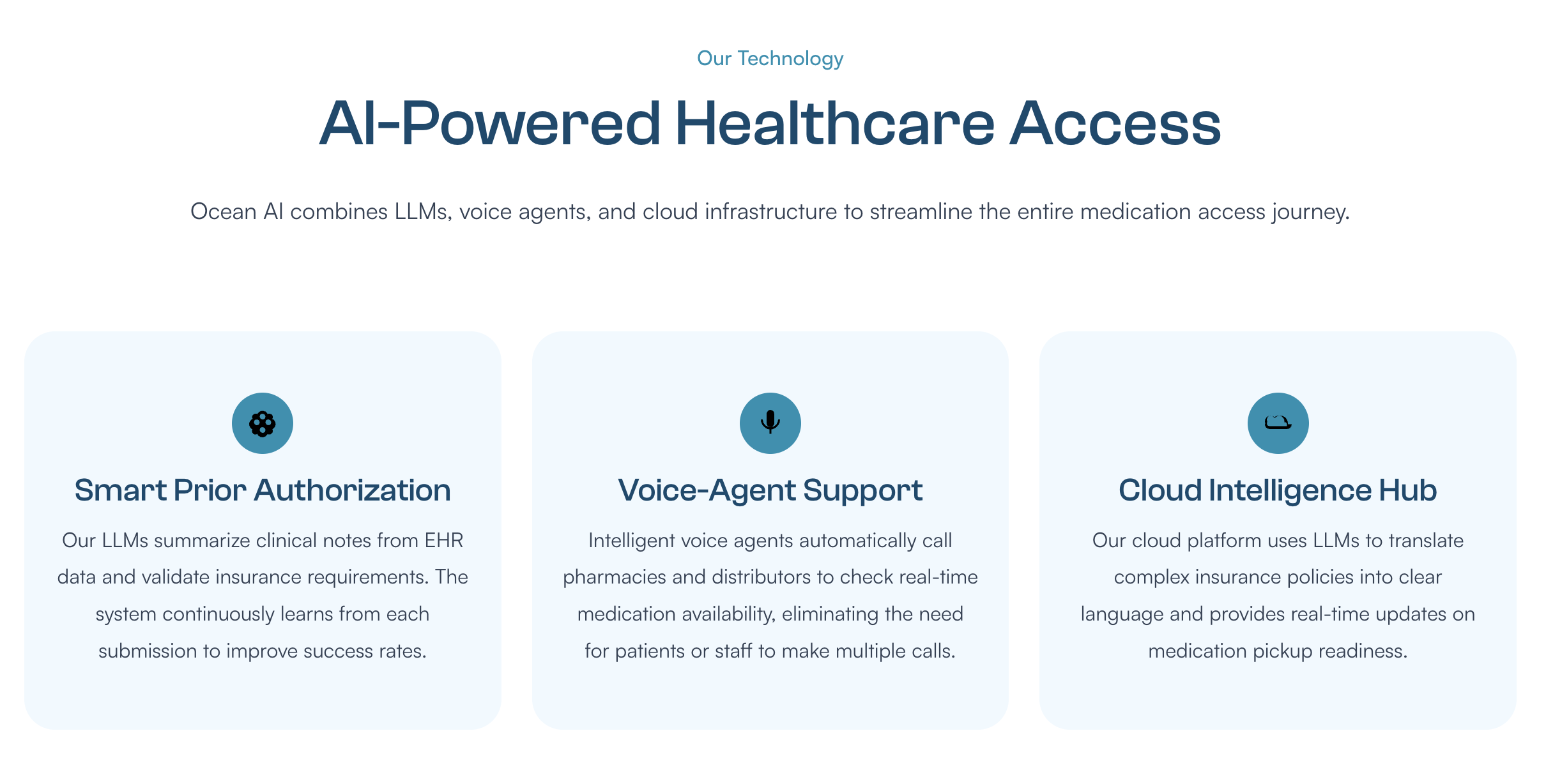
OceanAI: Prior Authorization for Health Care
Startup prototype, Winter 2025. With Alexa Murray and Neel Narayan.
Built a demo of an LLM system that drafts prior-authorization requests from patient records and insurance data.
Role: Built the website and the LLM query layer, including retrieval and a FAISS/Redis cache.
More projects
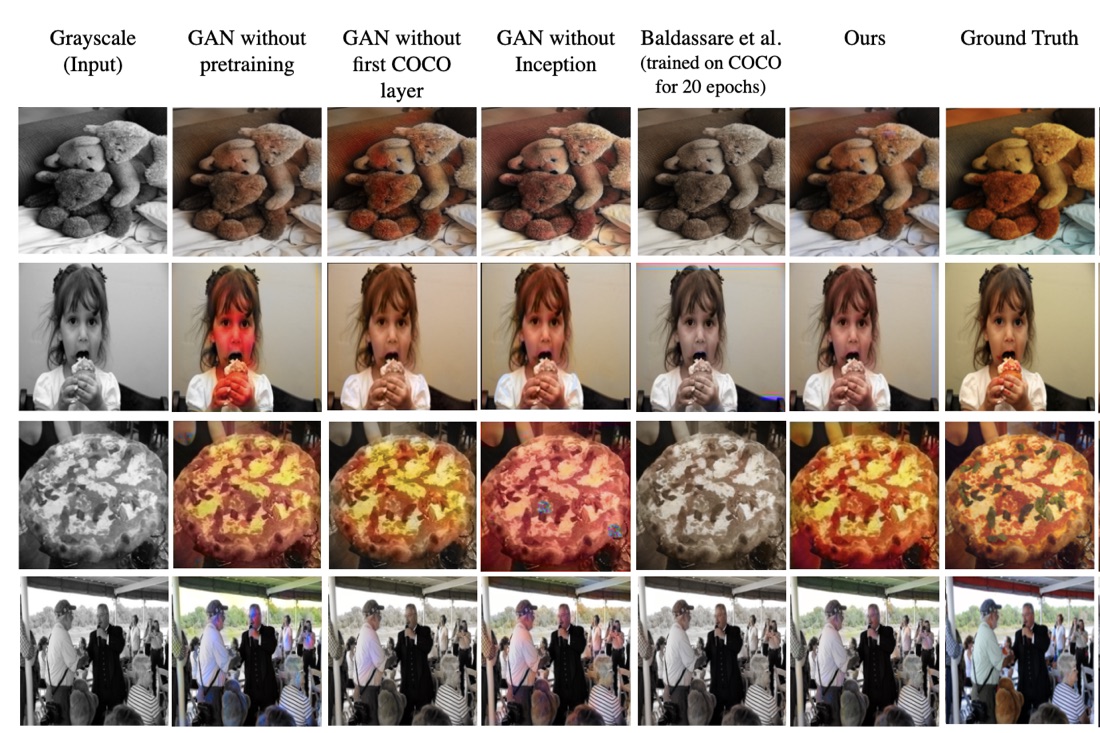
GAN-based Image Colorization Model
CS 231N Final Project, Spring 2024.
Developed a generative adversarial network (GAN) that colorizes grayscale images using semantic features extracted from a pre-trained Inception-ResNet-v2 model.
Role: Designed and implemented the model architecture, trained it using PyTorch and CUDA, and optimized performance metrics.
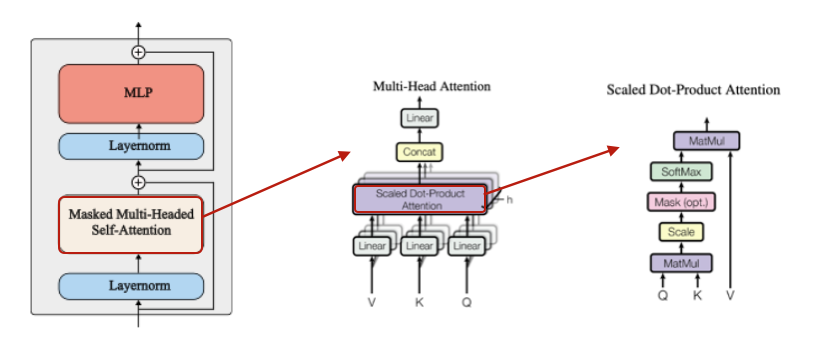
ExpLoRA: Exploring LoRA, SMART, and SOAP to Finetune GPT-2 for Downstream Tasks
CS 224N Final Project, Winter 2025.
Analyzed the performance of LoRA, SMART, and SOAP finetuning techniques on GPT-2 for various downstream tasks.
Role: Implemented SOAP and top-k sampling and evaluated their performance on chosen downstream tasks.
Selected Coursework
AI and Decision-Making
- CS 221M: Mechanistic Interpretability
- CS 238V: Validation of Safety-Critical Systems
- CS 238: Decision Making under Uncertainty
- CS 361: Engineering Design Optimization
- CS 231N: Deep Learning for Computer Vision
- CS 224N: NLP with Deep Learning
- CS 205L: Continuous Mathematical Methods with an Emphasis on Machine Learning
- CS 323: The AI Awakening: Implications for the Economy and Society